NICECX One

NICE CX Bundle Pricing packages with omnichannel features, voice and digital agents, and AI-powered contact center solutions

NICE CXone Training: Bundle Pricing & Understanding Voice & Digital Agents

NICE CX Bundle Pricing: Complete Guide to Packages & Cost NICE CX Bundle Pricing is designed to help organizations choose the right contact center capabilities based on their business needs. Instead of purchasing each feature separately, NICE CX groups features into bundles, allowing companies to select the level of functionality that matches their operations. In NICE CX, pricing typically depends on per agent per month, and the cost increases depending on the features included in the selected bundle. Businesses that require advanced capabilities such as AI automation, workforce management, or omnichannel routing will choose higher bundles compared to companies that only need basic contact center functions. Understanding NICE CX Bundle Pricing helps businesses select the right package while managing operational costs efficiently. What is NICE CX Bundle Pricing? NICE CX Bundle Pricing means that contact center features are grouped into different packages, each offering a specific set of capabilities. Some organizations may require only basic call center functionality, while others need advanced automation, analytics, and omnichannel communication tools. The bundle pricing model allows businesses to scale their contact center features based on their needs. Key factors affecting NICE CX pricing • Omnichannel routing • Workforce management • Quality management • Analytics and reporting • AI automation • Knowledge management The more advanced the feature set, the higher the bundle price. NICE CX Pricing Model The NICE CX pricing structure follows a per agent / per month model. Important pricing points include: • Pricing is calculated per agent license • Monthly subscription cost per agent • Feature bundles increase pricing • DID numbers or AI usage may add additional cost This flexible pricing structure allows organizations to start with a basic bundle and upgrade as their customer service operations grow. Voice Agent vs Digital Agent in NICE CX A critical concept when understanding NICE CX Bundle Pricing is the difference between Voice Agents and Digital Agents. Voice Agent A Voice Agent handles traditional phone calls and voice interactions. Examples include: • Inbound customer support calls • Outbound dialing campaigns • IVR interactions • Call transfers between agents Example scenario A customer calls a 1800 support number. The call flow usually follows this process: Customer Call → IVR Menu → Skill Routing → Voice Agent answers the call. Voice communication in NICE CX typically uses SIP and RTP protocols. Digital Agent A Digital Agent manages non-voice interactions where customers communicate through messaging or written channels. Examples include: • Live chat support • Email responses • WhatsApp messages • Social media messaging • SMS communication Example scenario A customer sends a WhatsApp message or email to a company for support. The system routes the message through NICE CX digital routing and assigns it to a Digital Agent, without requiring a phone call. Omnichannel Communication in NICE CX In real-world contact centers, voice and digital agents work together. This integrated approach is called Omnichannel Customer Experience. With NICE CX, businesses can manage interactions across multiple channels including: • Phone calls • Live chat • Email • WhatsApp • Social media • SMS Omnichannel routing ensures customers receive consistent support regardless of the channel they choose. NICE CX Bundle Pricing Packages NICE CX Bundle Pricing offers five main packages designed to support different business requirements. 1️⃣ CXone Power Omnichannel Suite Basic omnichannel capabilities for contact centers. Approximate pricing: $110 per agent / month 2️⃣ CXone Power Essential Suite Includes additional contact center management features. Approximate pricing: $135 per agent / month 3️⃣ CXone Power Core Suite Provides more advanced capabilities for larger operations. Approximate pricing: $169 per agent / month 4️⃣ CXone Power Complete Suite Adds workforce management and analytics features. Approximate pricing: $209 per agent / month 5️⃣ CXone Power Ultimate Suite The most advanced bundle including AI-driven automation. Approximate pricing: $249 per agent / month Feature Comparison Across Bundles Different bundles include different feature sets. Common capabilities include: • Voice and digital channels • Omnichannel routing and orchestration • Recording and compliance • Proactive engagement • AI routing • Outbound campaign management Some features are included directly in bundles, while others are available as add-ons. Important Notes About NICE CX Pricing There are a few important things to remember about NICE CX Bundle Pricing. • Some features are only available in higher bundles • Add-ons may require additional licensing • DID numbers and telephony usage may increase cost • AI usage may be billed separately Another key point is that NICE CX licenses cannot be purchased directly online. Businesses must contact NICE CX sales teams or authorized partners to get pricing details and implementation support. Conclusion NICE CX Bundle Pricing allows organizations to choose the right contact center capabilities based on their business requirements. By grouping features into bundles, NICE CX makes it easier for companies to scale their customer service infrastructure while controlling costs. Understanding the difference between Voice Agents and Digital Agents, along with the available bundles, helps organizations design an efficient omnichannel customer experience strategy. As customer communication continues to expand across voice and digital channels, platforms like NICE CX provide the flexibility and automation needed to deliver exceptional customer experiences.

NICE CXone Training: Bundle Pricing & Understanding Voice & Digital Agents Read More »
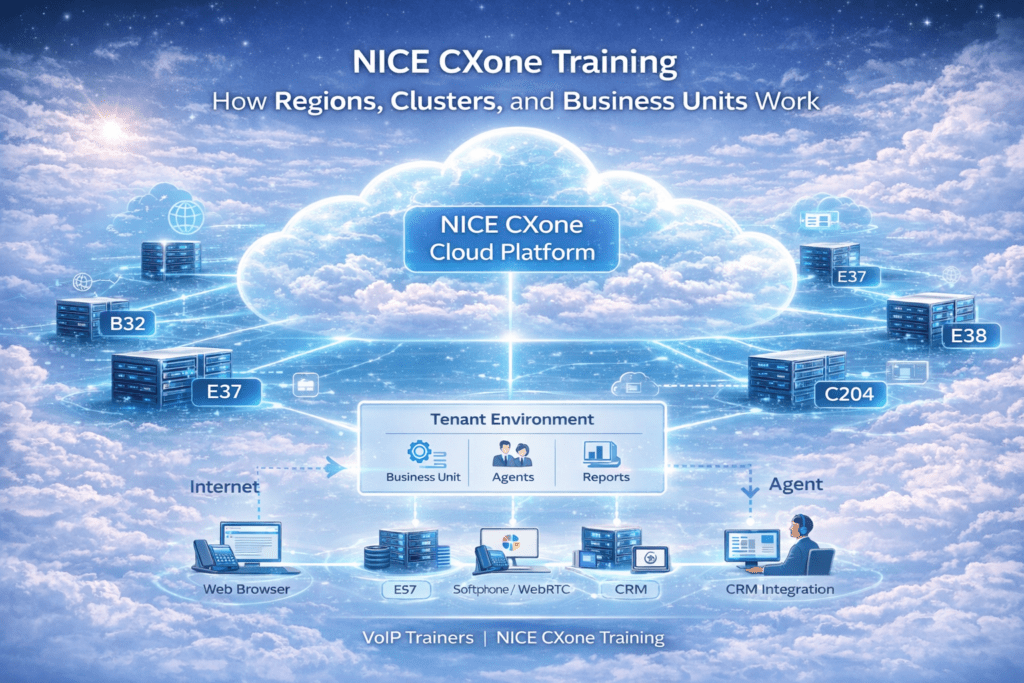
NICE CXone training diagram explaining region vs cluster and cloud contact center architecture

NICE CXone Training: How Regions, Clusters, and Business Units Work

NICE CXone training helps students understand cloud contact center platforms, including how regions and clusters work behind the scenes. One of the most common questions is about regions, clusters, and how the system actually works behind the scenes. These concepts may sound technical at first, but once you understand the logic, they become very easy to follow. In simple terms, NICE CXone is built on a cloud infrastructure where multiple regions and clusters work together to provide high availability and reliability. Why Does NICE CXone Have So Many Clusters? You may wonder why NICE creates multiple clusters inside a single region. The main reason is system reliability and performance. Large contact center platforms support millions of agents globally, so the infrastructure must be designed to handle huge traffic. NICE uses multiple clusters in one region for: Load distribution – traffic is balanced across multiple data centers High availability – if one cluster fails, another cluster can handle the traffic Disaster recovery – backup systems are always available Infrastructure expansion – new clusters can be added when demand grows New customer provisioning – different customers can be hosted on different clusters This architecture ensures that the platform remains stable even if one part of the system faces issues. Difference Between Region and Cluster Many beginners get confused between region and cluster, but the difference is actually very simple. A region represents a geographic location or country where NICE CXone services are hosted. A cluster, on the other hand, is a specific data center inside that region. For example: Region decides: Data residency Network latency Compliance requirements Cluster decides: Exact FQDN (Fully Qualified Domain Name) Exact IP addresses Exact service endpoints So first the system routes you to a region, and then inside that region, your environment runs on a specific cluster. How to Know Which Cluster Your Tenant Is In Every organization using NICE CXone has its own tenant environment. The easiest way to identify your cluster is through the login URL. For example, if your login URL contains something like: home-b32.nice-incontact.com This means your tenant is hosted in Cluster B32. Similarly, another tenant might be hosted on Cluster C204 or Cluster E38, depending on the infrastructure assigned by NICE. Understanding this concept is very important during NICE CXone Training, because engineers often need to check cluster details when working with integrations or troubleshooting issues. What is a Web Server ID? Another important concept is the Web Server ID. When you log in to the NICE CXone platform, your request is handled by one of the web servers inside the cluster. You can identify the web server by pressing Ctrl + A on the agent or admin page. The system will display the Web Server ID (for example: WEB01). This information becomes very useful when: Raising a support ticket Troubleshooting login issues Configuring integrations like SIP trunks or CRM connections The web server ID helps the support team identify which server your session is connected to. What is a Business Unit in NICE CXone? Another term that often confuses beginners is Business Unit. In simple terms: A Tenant represents your organization’s environment in NICE CXone. Inside the tenant, there is a Business Unit, which is mainly used for billing and subscription management. If you are familiar with Genesys terminology, you can think of it similar to an Organization ID. When creating support tickets or managing subscriptions, the Business Unit ID helps NICE identify your account. Conclusion NICE CXone training helps learners clearly understand how regions, clusters, and supporting components work together to build a reliable and scalable cloud contact center platform. By breaking down complex concepts like load distribution, failover, web server IDs, and business units, professionals can easily grasp how the system operates behind the scenes. NICE CXone training also provides practical knowledge that is essential for real-world scenarios such as troubleshooting issues, identifying cluster environments, and managing integrations effectively. This understanding ensures better system performance, stability, and seamless customer interactions. In conclusion, mastering these core concepts through NICE CXone training is a crucial step for students and IT professionals who want to build a successful career in cloud contact center technology and confidently work with CXone environments.

NICE CXone Training: How Regions, Clusters, and Business Units Work Read More »

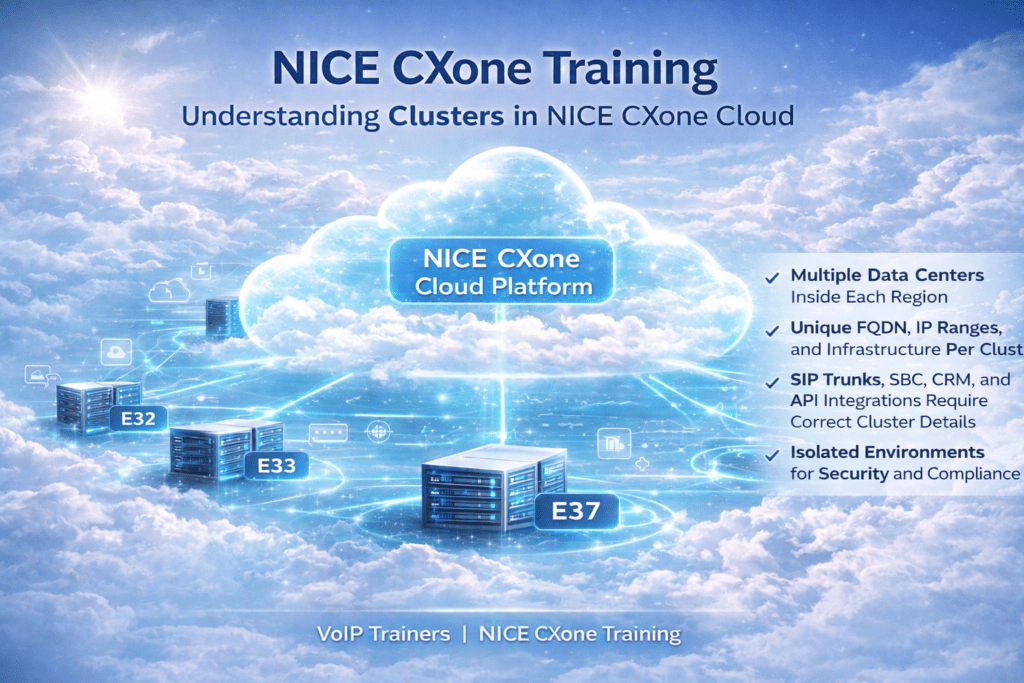
NICE CXone training cluster architecture showing regions clusters FQDN and IP integration flow

NICE CXone Training: Understanding Clusters in NICE CXone Cloud

NICE CXone training helps professionals understand the infrastructure behind cloud contact center platforms, which is essential for building scalable and reliable systems. One key concept covered in NICE CXone training is the cluster architecture used by the NICE CXone cloud platform. NICE CXone operates through multiple regions, data centers, and clusters to provide high availability and scalability for contact centers around the world. What is a Cluster in NICE CXone? A cluster is a group of servers inside a region that hosts customer environments (tenants). Each region contains multiple clusters (data centers). These clusters help distribute the workload and support many customers at the same time. The main reasons for having multiple clusters are: Load distribution High availability Disaster recovery Scalability of the cloud platform If one data center becomes overloaded or unavailable, another cluster in the same region can continue supporting the system. Cluster ID in NICE CXone Each cluster has a unique cluster ID such as: E32 E33 E34 E37 E38 These cluster IDs identify the specific data center where the tenant environment is hosted. Even though many customers may exist in the same region, each tenant runs inside its assigned cluster. This concept is commonly explained during NICE CXone Training because it helps engineers understand where the environment is actually running. FQDN and IP Address of Clusters Every cluster has its own: Login URL FQDN (Fully Qualified Domain Name) IP address ranges This information is important when integrating external systems with NICE CXone. For example, when integrating: AudioCodes SBC SIP Trunks Salesforce CRM Other telephony systems the integration must use the correct cluster FQDN and IP address. If the wrong cluster information is used, the calls may fail. The NICE CXone portal provides connection details such as DNS records, IP ranges, and required ports, which must be configured or whitelisted during integrations. Why Cluster Knowledge is Important Understanding clusters helps engineers and administrators configure integrations correctly and troubleshoot connectivity issues. This is why topics like cluster IDs, FQDN configuration, SIP trunk integration, and region architecture are key parts of NICE CXone Training. NICE CXone Training at VoIP Trainers If you want to build a career in cloud contact center technologies, learning the platform architecture is the first step. At VoIP Trainers, we provide practical NICE CXone Training that helps students, engineers, and professionals understand real-world implementations including clusters, integrations, and cloud contact center architecture. Conclusion NICE CXone training helps professionals understand how cluster architecture plays a critical role in ensuring scalability, high availability, and seamless performance in cloud contact center platforms. By learning about clusters, cluster IDs, FQDN, and IP configurations, engineers and administrators can effectively manage integrations and maintain stable system connectivity. NICE CXone training also highlights how multiple clusters within a region work together to distribute workloads and support failover, ensuring uninterrupted customer interactions. This knowledge is essential for troubleshooting issues, configuring SIP integrations, and optimizing overall system performance. In conclusion, mastering cluster architecture through NICE CXone training is a key step for anyone looking to build a strong career in cloud contact center technology and handle real-world CXone environments with confidence.

NICE CXone Training: Understanding Clusters in NICE CXone Cloud Read More »

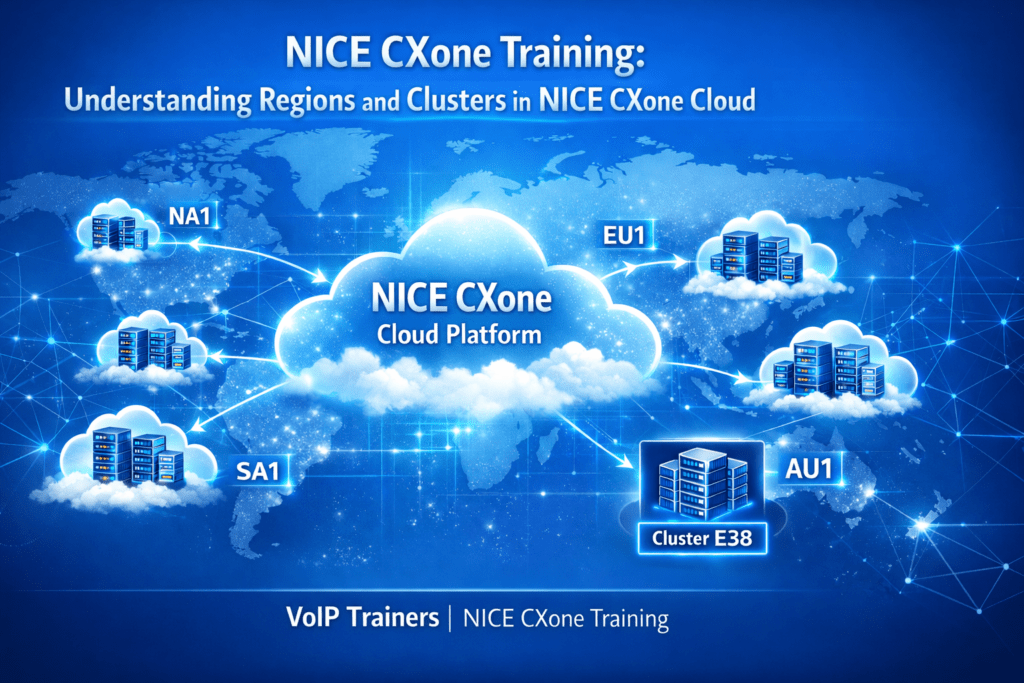
NICE CXone training region and cluster architecture showing global regions and failover clusters

NICE CXone Training: Understanding Regions and Clusters in NICE CXone Cloud

NICE CXone training helps professionals understand how cloud contact center platforms deliver reliable, scalable, and globally accessible services. One of the most important concepts professionals learn during NICE CXone training is how regions and clusters work inside the platform. Understanding these concepts helps engineers and administrators know where the system is hosted and how the platform maintains high availability and performance. This article explains the architecture in a simple way so that students, IT professionals, and engineers learning NICE CXone can easily understand how the infrastructure is organized. What is a Region in NICE CXone? In NICE CXone, a region represents the physical geographic location where customer data and services are hosted. Each region contains multiple data centers that run the NICE CXone cloud platform. This regional architecture helps the system deliver faster performance, improved security, and better reliability. Using a region-based architecture provides several benefits: • Lower network latency • Better call quality • Data residency compliance • Improved disaster recovery capabilities By hosting services closer to users, the platform ensures smoother customer interactions. Global Regions Available in NICE CXone Currently, NICE CXone operates across several major global regions: • North America • US FedRAMP • Europe • Asia-Pacific • Australia • South Africa Each region contains multiple clusters that host customer environments and provide redundancy for high availability. Learning about these regions is an important part of NICE CXone Training because it helps engineers understand where customer environments are deployed. What is a Region Code? Every region in NICE CXone has a region code, which is a short identifier used to represent the geographic location of the platform. Region codes are often visible in login URLs and system configurations. Some common examples include: • EU1– Europe • NA1– North America • AU1 – Australia When users log into the platform, the region code indicates where the tenant environment is hosted. Understanding region codes helps administrators identify system environments quickly. What is a Cluster in NICE CXone? A cluster is a specific data center inside a region where NICE CXone services run. Each region contains multiple clusters to support scalability and redundancy. For example: If a company is hosted in the Europe region (EU1), its environment may run on cluster E38. This means the organization’s services and data are physically hosted inside the infrastructure of that specific cluster. Clusters are critical for maintaining performance and distributing system workloads. Because of this, understanding clusters is an important concept explained in NICE CXone Training. Primary Cluster and Failover Cluster When a new tenant environment is created in NICE CXone, the system assigns a primary cluster where the organization’s services operate. However, to ensure reliability, the platform also maintains backup clusters within the same region. If the primary cluster experiences an issue, the platform can automatically move services to another cluster in the same region. For example: If a tenant is hosted on cluster M32, the system might fail over to M33 or M35 within the North America region. Keeping failover clusters within the same region ensures: • Data residency compliance • Regulatory compliance • Minimal latency impact This architecture ensures continuous service availability. Why Region Selection is Important? Selecting the correct region plays a major role in performance and compliance. Organizations usually choose a region that is geographically closer to their users. This helps reduce latency and improve voice quality. For example: Organizations in India or the Middle East are often hosted in the Europe region because it provides better network connectivity and lower communication delays. Understanding region selection is a key concept discussed in NICE CXone Training programs. Conclusion NICE CXone training helps professionals clearly understand how regions and clusters form the foundation of a reliable and scalable cloud contact center architecture. By learning how regions define geographic hosting and how clusters manage workloads within those regions, engineers and administrators can better ensure high availability, performance, and compliance. NICE CXone training also highlights the importance of region codes, primary clusters, and failover clusters in maintaining continuous service without disruption. This architecture ensures that even during failures, the system can quickly recover while maintaining data integrity and minimal latency. In conclusion, mastering regions and clusters through NICE CXone training is essential for anyone looking to build expertise in cloud contact center technology and effectively manage real-world CXone environments. Learn more in our NICE CXone Training course

NICE CXone Training: Understanding Regions and Clusters in NICE CXone Cloud Read More »

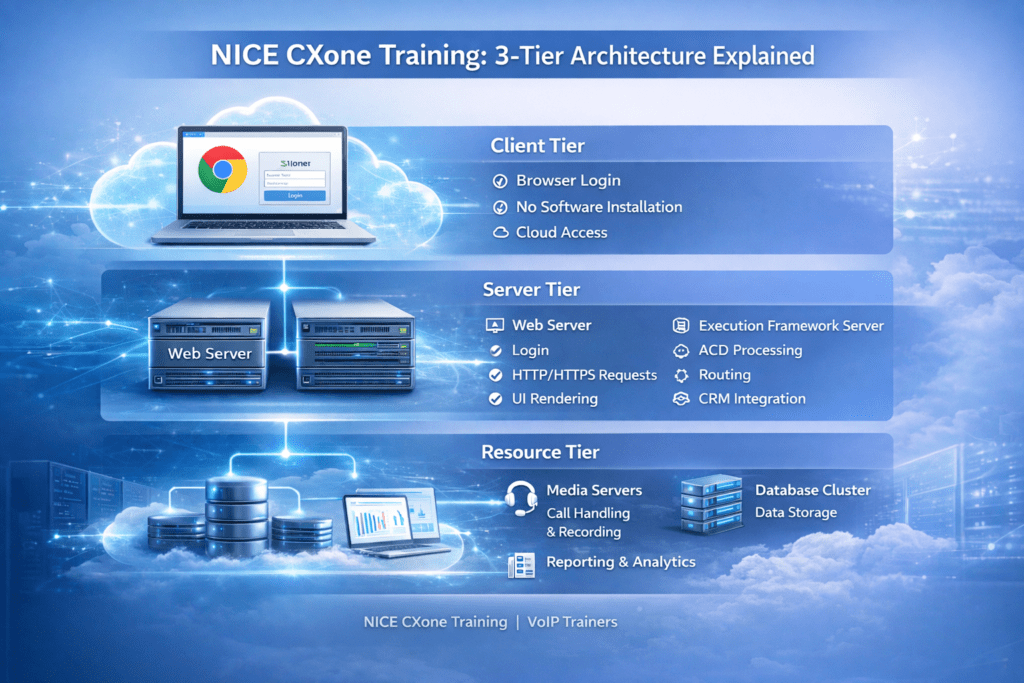
NICE CXone training 3 tier architecture diagram showing client server and resource layers

NICE CXone Training: 3-Tier Architecture Explained

NICE CXone training helps professionals understand how modern contact centers are rapidly moving toward cloud platforms to improve flexibility, scalability, and global accessibility. Modern contact centers are rapidly moving toward cloud platforms to improve flexibility, scalability, and global accessibility. One of the most widely used cloud contact center platforms today is NICE CXone. For students, IT professionals, and engineers who want to build a career in cloud contact center technology, understanding the internal architecture of NICE CXone is extremely important. This article explains the platform in a simple and practical way. The concepts discussed here are commonly covered in NICE CXone Training and NICE CX Training programs. What is NICE CXone? NICE CXone is a cloud-based Contact Center as a Service (CCaaS) platform that helps organizations manage customer interactions across voice, chat, email, and digital channels. Because it runs entirely in the cloud, businesses can operate contact centers without installing complex hardware or infrastructure. Agents can work from anywhere using only a web browser and internet connection. To support millions of interactions reliably, NICE CXone uses a powerful 3-Tier Cloud Architecture. 3-Tier Architecture in NICE CXone The platform is designed using a 3-Tier Architecture, which separates the system into different layers. Each layer performs a specific function in the overall platform. The three tiers include: Client Tier Server Tier Resource Tier This layered architecture improves: • System performance • Security • Scalability • Reliability Because each layer handles a different responsibility, the platform can scale efficiently when more agents or customers are added. Understanding this architecture is a key concept taught in NICE CXone Training programs. Client Tier – Browser Based Access The Client Tier is the front-end layer where users interact with the platform. This includes: • Contact center agents • Supervisors • Administrators One of the biggest advantages of NICE CXone is that it is completely browser based. Agents can access the system using web browsers like Google Chrome, without installing any software on their computers. The process is simple: Open the browser Navigate to the NICE CXone login portal Enter credentials Start handling customer interactions Because the platform is cloud based, organizations can easily support: • Remote agents • Work-from-home teams • Global contact center operations This flexibility is one of the main reasons companies adopt NICE CXone. Server Tier – Processing and Application Logic The Server Tier is the core processing layer of the platform. It receives requests from the browser and executes the main system logic required to operate the contact center. Two important components exist in this layer. Web Server The Web Server manages communication between the user’s browser and the NICE CXone system. It handles several important tasks including: • Login authentication • HTTP and HTTPS communication • Loading the user interface • Managing user sessions Whenever an agent logs in through Google Chrome, the request first reaches the web server before being processed further. The web server ensures secure communication between the user and the platform. Execution Framework Server The Execution Framework Server is responsible for the core operational logic of the contact center. This includes several critical processes such as: • ACD (Automatic Call Distribution) • Intelligent call routing • Queue management • Workflow automation • CRM integrations When a customer calls the contact center, this server determines which agent should receive the interaction. Routing decisions are based on factors like: • Agent skills • Agent availability • Priority rules • Business workflows These processes allow organizations to deliver efficient customer service. Resource Tier – Infrastructure and Data Layer The Resource Tier forms the infrastructure backbone of the platform. This layer supports the entire system by managing communication services, storage, and analytics. Several key components operate in this tier. Media Servers Media servers handle real-time communication between customers and agents. They manage services such as: • Voice call processing • Call recording • Audio streaming • Voice quality optimization These servers ensure that voice interactions happen smoothly without delays or interruptions. Database Clusters Database systems store the critical data required for contact center operations. This includes: • Agent configurations • Customer interaction records • Call history • System settings Database clustering ensures high availability and prevents data loss. Reporting and Analytics Systems Reporting and analytics tools collect operational data and generate performance insights. Organizations use these insights to monitor: • Agent productivity • Call handling time • Queue performance • Customer satisfaction metrics These analytics systems help managers optimize contact center operations. Why Understanding NICE CXone Architecture is Important Learning how NICE CXone works internally is valuable for professionals who want to build a career in cloud contact center technologies. Architecture knowledge helps professionals: • Troubleshoot platform issues • Design scalable contact center solutions • Understand call routing mechanisms • Integrate external systems such as CRM platforms For this reason, architecture concepts are an essential part of most NICE CXone Training courses. Conclusion NICE CXone training provides a clear understanding of how modern cloud contact centers operate using a powerful 3-tier architecture that ensures scalability, performance, and reliability. By learning how the client tier, server tier, and resource tier work together, professionals can better manage customer interactions and maintain seamless operations. NICE CXone training also helps individuals understand critical components such as web servers, application logic, media servers, and database clusters, which play a key role in delivering efficient and secure communication. This knowledge is essential for troubleshooting issues, optimizing performance, and designing scalable contact center solutions. In conclusion, mastering these architectural concepts through NICE CXone training is crucial for students and IT professionals who want to build a successful career in cloud contact center technology and stay ahead in a rapidly evolving digital environment.

NICE CXone Training: 3-Tier Architecture Explained Read More »

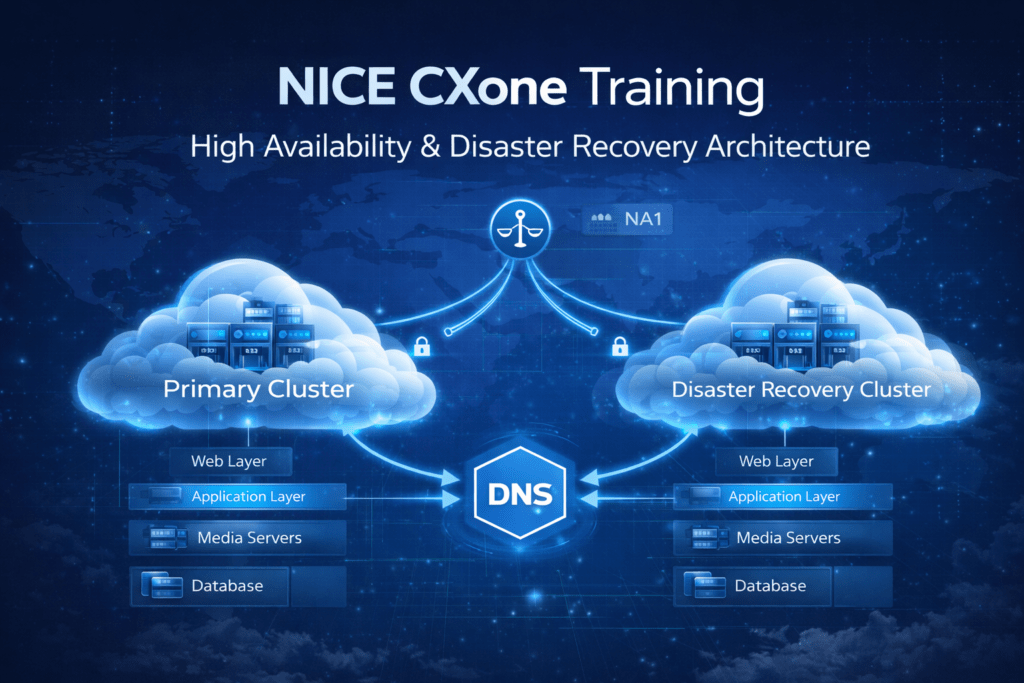
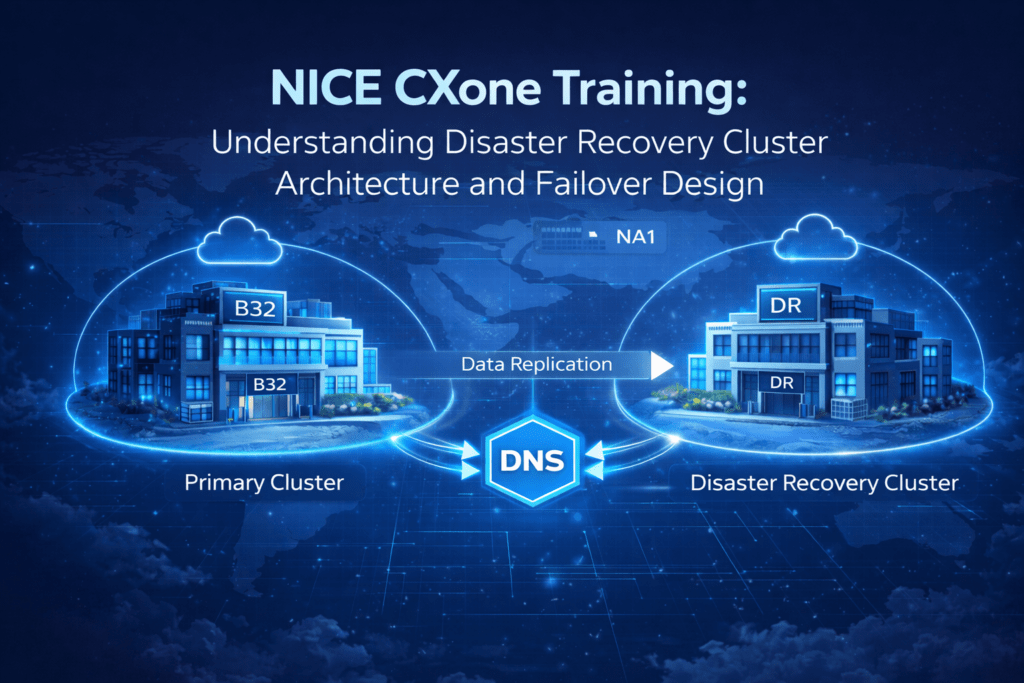
NICE CXone Training disaster recovery architecture showing primary and DR clusters with DNS failover

Understanding High Availability and DR Architecture in NICE CXone

NICE CXone Training: Understanding High Availability and DR Architecture in NICE CXone NICE CXone Training is essential for professionals who want to understand how modern cloud contact centers maintain high availability, reliability, and business continuity. One of the most important concepts covered in NICE CXone Training is Disaster Recovery Architecture, which explains how the platform protects services during infrastructure failures. In a cloud contact center environment, system stability is critical because even a short outage can disrupt customer communication. To prevent this, NICE CXone uses a multi-layer architecture with primary clusters, disaster recovery clusters, load balancing, and database replication. Understanding how these components work together helps engineers, administrators, and IT professionals manage CXone environments effectively and ensure uninterrupted contact center operations. To understand this let us visualize the architecture. The primary cluster typically includes the web layer, application layer, media services and database. The Disaster Recovery cluster mirrors this structure with the web layer, application layer, media services and a replicated database. The key concept here is replication. Data from the database is continuously replicated to the Disaster Recovery database. The Disaster Recovery cluster remains in mode, synchronized and ready to take over if something happens to the primary cluster. It is not active, under conditions but it is always prepared to take over. This standby model ensures that when failover occurs services can resume quickly with disruption. Modern contact centers cannot afford to be. It does not matter if call demand is high or low the platform must stay stable, responsive and resilient. This is where Disaster Recovery architecture plays a role in NICE CXone. If you are looking into CXone training you need to understand how Disaster Recovery clusters, load balancing and service layers work together. Let us break it down clearly. Disaster Recovery Architecture Overview – Region NA1 Example In a NICE CXone regional deployment, like NA1 the infrastructure includes: * Primary Cluster, which is B32 * Disaster Recovery Cluster, which is C48 * Web Servers * Application Servers * Media Servers * Database Layer, which includes Primary and Replicated Both clusters are in the region but work independently. The Disaster Recovery cluster is on standby, synchronized and ready to take over if the primary cluster becomes unavailable. This architecture makes sure that NICE CXone has: * Business continuity * availability * Minimal service disruption * Controlled failover The first layer is the Load Balancer, which controls traffic distribution. It sits at the entry point of the system. Its job is to: * Distribute HTTPS traffic across web servers * Prevent overload on a server * Ensure session stability * Redirect traffic during failover When user traffic enters the region the load balancer decides which web server will handle the request. If there is a problem with the cluster traffic is redirected to the Disaster Recovery cluster without manual help. Understanding this traffic distribution layer is important in CXone training because it affects login stability, agent availability and overall system responsiveness. The second layer is the Web Servers, which handle: * Agent login requests * UI rendering * HTTPS requests * Session handling It is important to note that web servers do not process voice traffic. They only manage front-end communication between users and the application layer. If web servers are busy the load balancer distributes traffic evenly across web servers. In NICE CXone training it is crucial to understand the difference between UI traffic and media traffic for troubleshooting. The third layer is the Application Servers, which process: * Routing logic * Workflows * Queue handling * Business rules * Integration logic * Database communication When an agent performs an action in the UI the request goes from the web server to the application server to the database and back to the web server. Application servers make sure workflows are executed correctly and consistently. If demand changes auto-scaling policies may. Remove application instances to maintain performance. In CXone training this layer is where most configuration knowledge is applied, including skills, routing, scripts and policies. The fourth layer is the Media Servers, which handle: * RTP streams * Voice session establishment * Agent-to-customer audio connection * Call recording triggers Unlike web and application servers media servers process real-time voice packets. This separation ensures that UI performance does not affect call quality and voice processing remains stable. During failover scenarios media services transition to the Disaster Recovery cluster to maintain call continuity. This architecture design is a concept in advanced NICE CXone training especially when explaining voice troubleshooting and RTP behavior. The fifth layer is the Database, which stores: * User data * Call logs * Reporting data * Configuration settings * Historical analytics In the cluster the main database handles live writes. In the Disaster Recovery cluster a replicated database remains synchronized. This replication ensures that there is no data loss and immediate failover capability, which’s essential for business continuity compliance. Understanding replication behavior is vital in NICE CXone training programs. The full call flow in the architecture is like this: * Agent logs in which goes to the Web Server * Authentication request goes to the Application Server * Configuration fetch goes to the Database * Incoming call goes to the Media Server * RTP session is established * Call logs are written to the Database * Reporting data is generated Each layer has a job and there is no overlap or confusion. This layered separation increases system reliability and simplifies troubleshooting. What happens if the primary cluster fails? If Cluster B32, which is the cluster experiences failure: * The load balancer stops directing traffic to B32 * Traffic shifts to Cluster C48, which’s the Disaster Recovery cluster * The replicated database becomes * Web, application and media services resume operations The goal is to have zero or minimal service interruption. This is why Disaster Recovery clusters exist within the region to provide rapid recovery while maintaining compliance and latency control. There are times when call demand’s low such as during seasonal business cycles, off-peak

Understanding High Availability and DR Architecture in NICE CXone Read More »

NICE CXone Training Disaster Recovery architecture with primary and DR clusters in same region

Understanding Disaster Recovery Cluster Architecture and Failover Design

NICE CXone Training sessions, Disaster Recovery is one of the most discussed but least understood topics. Many professionals think it is just a backup system somewhere in the world. But in NICE CXone, Disaster Recovery is a region-aware, tightly controlled cloud architecture design. In cloud platforms like CXone, Disaster Recovery is not just about having a backup somewhere in the world. It is actually a designed system that is aware of the region it is in and is tightly controlled. For those interested in enhancing their knowledge, participating in nice cxone training is essential to understand these concepts deeply. Additionally, this nice cxone training provides insights into best practices for managing Disaster Recovery effectively and ensuring a robust operational strategy Is the Disaster Recovery Cluster in the Same Region as the Primary Cluster? NICE CXone Training explains that the Disaster Recovery cluster is in the same region as the primary cluster but located in a different physical data center. For example if your environment is hosted in Region NA1 both your primary cluster and your Disaster Recovery cluster are in NA1. They are located in separate physical facilities. Think of it like this: your company has an office and a backup office in the same city. If something happens to the office like a fire or a power failure your employees can immediately move to the backup office. The city is still the same. The building is different. This is a key concept covered in NICE CXone Training, especially when understanding cluster architecture and regional failover design. Your primary cluster might be called B32 and your Disaster Recovery cluster might be called C48. Both are in NA1. They are in different data centers to protect against physical failures. Understanding the intricacies of Disaster Recovery is crucial, and that’s why comprehensive nice cxone training is available to guide you through the process. Why Do We Keep the Disaster Recovery Cluster in the Same Region? This is a question that many people ask. Why not just switch from NA1 to EU1 if something happens? There are three reasons for this. Understanding this regional architecture is critical for architects, administrators, and anyone undergoing NICE CXone Training. First there are data compliance laws. Many countries have laws about where data can be stored and customer data must remain within a specific geography. If we move data from NA1 to EU1 during a Disaster Recovery event it could violate these laws. Second there is the issue of latency consistency. If your users and telecom carriers are set up to connect within NA1 suddenly moving traffic to a continent would increase latency and affect call quality and application performance. Third there are telecom requirements. Voice and media infrastructure is tightly. Routing voice traffic outside its designated region is not always allowed. Because of these reasons NICE CXone cannot randomly switch workloads from NA1 to EU1 during a disaster. The Disaster Recovery cluster must stay within the region. Can We Choose Our Disaster Recovery Cluster? The short answer is no customers cannot choose their Disaster Recovery cluster. The Disaster Recovery pairing is set up as part of the platform architecture. It is designed and managed by the NICE architecture team. It is not something that customers can configure themselves. This ensures that everything is standardized and it makes it easier to test and manage the system. From an architecture perspective controlled Disaster Recovery pairing reduces complexity and avoids misconfiguration risks. So while customers can see their cluster the Disaster Recovery pairing happens behind the scenes. How Do We Find Out What Our Standby Cluster Is? If the Disaster Recovery cluster is not visible how do we find out what it is? There are two ways to do this. First we can reach out to Support or our Account Team and ask them to confirm our Disaster Recovery cluster pairing for our business unit. Second some large enterprise customers may receive architecture or network design documentation that includes information about their Disaster Recovery pairing. Otherwise the Disaster Recovery cluster remains hidden.. That is by design. How Does Failover Work? Now let us talk about what happens during a failure. Failover is controlled at the DNS and routing layer. The URL of our website does not. Users do not need to do anything. Behind the scenes DNS updates redirect traffic from the cluster to the Disaster Recovery cluster. This happens automatically. Users may not even notice that the backend cluster has changed. DNS-based failover ensures high availability, minimal downtime, and seamless user experience — core principles emphasized in NICE CXone Training programs. The transition happens at the infrastructure level not at the user level. Conclusion NICE CXone Training clearly shows that Disaster Recovery is not just a simple backup system but a well-designed, region-aware cloud architecture that ensures high availability and business continuity. By keeping primary and Disaster Recovery clusters within the same region, CXone maintains compliance, reduces latency, and meets telecom requirements without compromising performance. NICE CXone Training also highlights how automated DNS-based failover works seamlessly in the background, ensuring that users experience minimal disruption during failures. This controlled and standardized approach makes the platform reliable, secure, and efficient for enterprise environments. In conclusion, understanding Disaster Recovery in CXone is essential for professionals who want to master real-world cloud contact center architecture and build strong technical expertise.

Understanding Disaster Recovery Cluster Architecture and Failover Design Read More »

NICE CXone Training smart cloud city architecture showing region cluster disaster recovery and failover

NICE CXone Architecture Explained as a Smart Cloud City

NICE CXone Training: NICE CXone Architecture Explained as a Smart Cloud City NICE CXone Training is essential for understanding cloud infrastructure, which often feels complex. Terms like regions, clusters, disaster recovery, and high availability can quickly become confusing. But when explained in a simple way, everything becomes easier to understand. Let’s break down NICE CXone architecture using a Smart Cloud City analogy so you can understand it clearly, even if you are a beginner. Understanding NICE CXone as a Smart Cloud City Think of NICE CXone as a highly advanced digital city that never sleeps. This smart city is responsible for managing all customer interactions, including calls, emails, chats, and messages. Just like a real city: It has infrastructure It has systems working together It runs 24/7 without interruption But unlike a normal city, this one is distributed globally to ensure performance and reliability. Region = Country in the Cloud In this Smart Cloud City, a Region can be compared to a country. For example: NA1 represents North America EU1 represents Europe AU1 represents Australia Each region is designed to serve users in that specific geographical location. Why Regions Are Important Regions play a critical role in cloud architecture because they help with: Data localization (keeping data in a specific country or region) Faster response times Compliance with local laws and regulations For instance, a company operating in Europe will prefer using the EU region to ensure that customer data remains within European boundaries. Cluster = Buildings Within the Country Inside each region (country), there are multiple clusters, which can be compared to buildings in a city. Each cluster includes: Application servers Databases Storage systems Instead of relying on a single system, workloads are distributed across multiple clusters. Why Clusters Matter Clusters improve the system by: Distributing traffic evenly Reducing system overload Increasing performance Ensuring reliability This setup ensures that even if one part of the system is busy, others can handle the load efficiently. Disaster Recovery (DR) – Backup System in Action Imagine a situation where one building in the city suddenly stops working due to a power failure. Does the entire city stop functioning? No. Another building immediately takes over operations. This concept is known as Disaster Recovery (DR). How It Works in NICE CXone Backup clusters are always available If the main cluster fails, traffic is automatically redirected Users experience little to no disruption This ensures that business operations continue without interruption. DNS Failover – Smart Traffic Redirection DNS Failover can be compared to traffic management in a smart city. If one road is blocked: Traffic is instantly redirected to another route Similarly, in cloud systems: If one server or endpoint is unavailable DNS automatically redirects users to a healthy system This plays a key role in maintaining high availability. Why NICE CXone Architecture Matters for Businesses For enterprises, downtime is not just an inconvenience—it can lead to revenue loss and customer dissatisfaction. NICE CXone architecture helps businesses by ensuring: Continuous system availability Strong data protection Compliance with global standards Seamless customer experience All these elements work together behind the scenes to deliver smooth and reliable customer interactions. Why Students Should Learn NICE CXone Architecture If you are planning a career in: Cloud computing Contact center technologies Technical support NICE CXone implementation Then understanding this architecture is very important. It helps you: Understand real-time system design Perform better in technical interviews Gain practical knowledge of cloud platforms Start Learning with Practical Training If you want to learn NICE CXone architecture with real-time examples, live scenarios, and practical sessions, you can start your training journey today. At VoIP Trainers, we provide industry-focused training to help students and professionals build strong technical skills. Feel free to connect with us to learn more about our training programs.

NICE CXone Architecture Explained as a Smart Cloud City Read More »