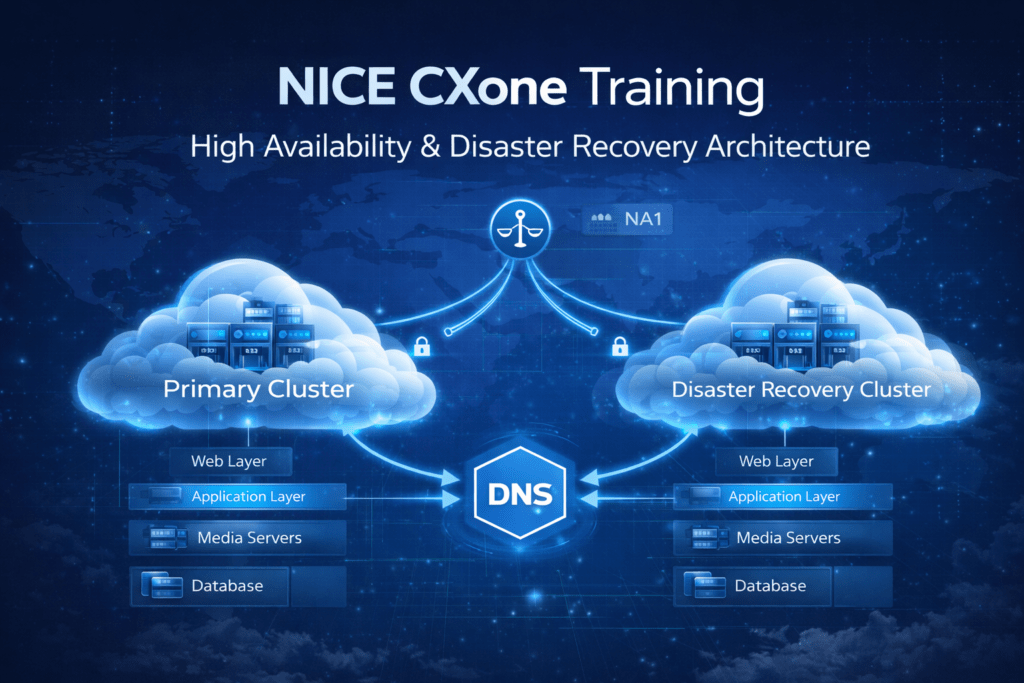
NICE CXone Training sessions, Disaster Recovery is one of the most discussed but least understood topics. Many professionals think it is just a backup system somewhere in the world. But in NICE CXone, Disaster Recovery is a region-aware, tightly controlled cloud architecture design. In cloud platforms like CXone, Disaster Recovery is not just about having a backup somewhere in the world. It is actually a designed system that is aware of the region it is in and is tightly controlled. For those interested in enhancing their knowledge, participating in nice cxone training is essential to understand these concepts deeply. Additionally, this nice cxone training provides insights into best practices for managing Disaster Recovery effectively and ensuring a robust operational strategy
Is the Disaster Recovery Cluster in the Same Region as the Primary Cluster?
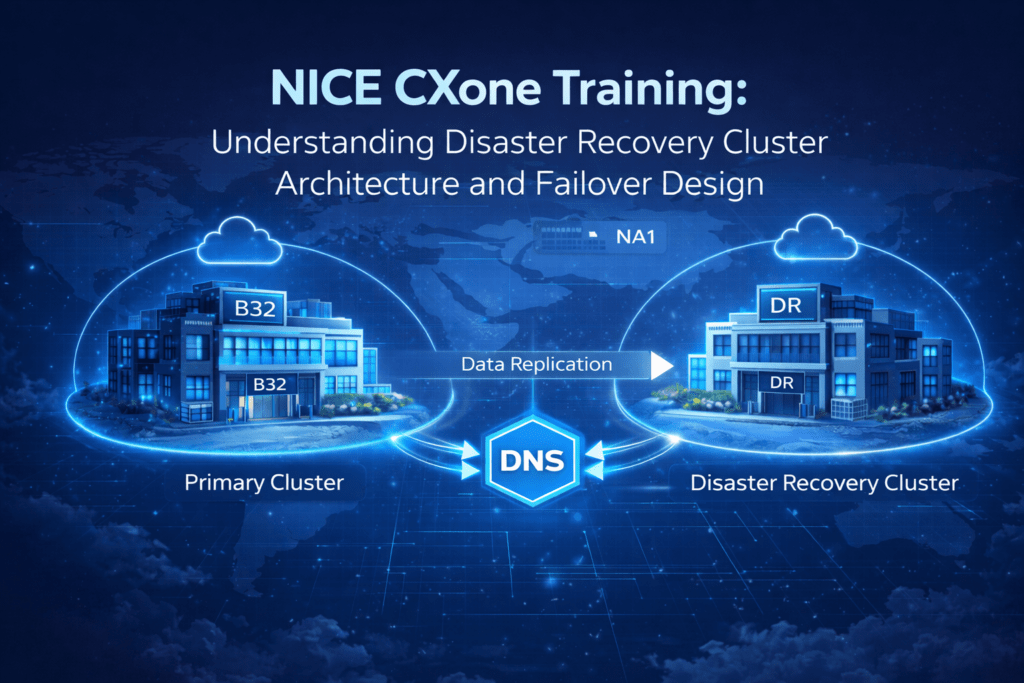
NICE CXone Training explains that the Disaster Recovery cluster is in the same region as the primary cluster but located in a different physical data center.
For example if your environment is hosted in Region NA1 both your primary cluster and your Disaster Recovery cluster are in NA1. They are located in separate physical facilities.
Think of it like this: your company has an office and a backup office in the same city. If something happens to the office like a fire or a power failure your employees can immediately move to the backup office. The city is still the same. The building is different.
This is a key concept covered in NICE CXone Training, especially when understanding cluster architecture and regional failover design. Your primary cluster might be called B32 and your Disaster Recovery cluster might be called C48. Both are in NA1. They are in different data centers to protect against physical failures.
Understanding the intricacies of Disaster Recovery is crucial, and that’s why comprehensive nice cxone training is available to guide you through the process.
Why Do We Keep the Disaster Recovery Cluster in the Same Region?
This is a question that many people ask. Why not just switch from NA1 to EU1 if something happens?
There are three reasons for this.
Understanding this regional architecture is critical for architects, administrators, and anyone undergoing NICE CXone Training.
First there are data compliance laws. Many countries have laws about where data can be stored and customer data must remain within a specific geography. If we move data from NA1 to EU1 during a Disaster Recovery event it could violate these laws.
Second there is the issue of latency consistency. If your users and telecom carriers are set up to connect within NA1 suddenly moving traffic to a continent would increase latency and affect call quality and application performance.
Third there are telecom requirements. Voice and media infrastructure is tightly. Routing voice traffic outside its designated region is not always allowed.
Because of these reasons NICE CXone cannot randomly switch workloads from NA1 to EU1 during a disaster. The Disaster Recovery cluster must stay within the region.
Can We Choose Our Disaster Recovery Cluster?
The short answer is no customers cannot choose their Disaster Recovery cluster.
The Disaster Recovery pairing is set up as part of the platform architecture. It is designed and managed by the NICE architecture team. It is not something that customers can configure themselves.
This ensures that everything is standardized and it makes it easier to test and manage the system. From an architecture perspective controlled Disaster Recovery pairing reduces complexity and avoids misconfiguration risks.
So while customers can see their cluster the Disaster Recovery pairing happens behind the scenes.
How Do We Find Out What Our Standby Cluster Is?
If the Disaster Recovery cluster is not visible how do we find out what it is?
There are two ways to do this.
First we can reach out to Support or our Account Team and ask them to confirm our Disaster Recovery cluster pairing for our business unit.
Second some large enterprise customers may receive architecture or network design documentation that includes information about their Disaster Recovery pairing.
Otherwise the Disaster Recovery cluster remains hidden.. That is by design.
How Does Failover Work?
Now let us talk about what happens during a failure.
Failover is controlled at the DNS and routing layer.
The URL of our website does not. Users do not need to do anything.
Behind the scenes DNS updates redirect traffic from the cluster to the Disaster Recovery cluster. This happens automatically. Users may not even notice that the backend cluster has changed.
DNS-based failover ensures high availability, minimal downtime, and seamless user experience — core principles emphasized in NICE CXone Training programs. The transition happens at the infrastructure level not at the user level.
Conclusion
NICE CXone Training clearly shows that Disaster Recovery is not just a simple backup system but a well-designed, region-aware cloud architecture that ensures high availability and business continuity. By keeping primary and Disaster Recovery clusters within the same region, CXone maintains compliance, reduces latency, and meets telecom requirements without compromising performance.
NICE CXone Training also highlights how automated DNS-based failover works seamlessly in the background, ensuring that users experience minimal disruption during failures. This controlled and standardized approach makes the platform reliable, secure, and efficient for enterprise environments.
In conclusion, understanding Disaster Recovery in CXone is essential for professionals who want to master real-world cloud contact center architecture and build strong technical expertise.