NICE CXone training helps professionals understand how cloud contact center platforms deliver reliable, scalable, and globally accessible services. One of the most important concepts professionals learn during NICE CXone training is how regions and clusters work inside the platform.
Understanding these concepts helps engineers and administrators know where the system is hosted and how the platform maintains high availability and performance.
This article explains the architecture in a simple way so that students, IT professionals, and engineers learning NICE CXone can easily understand how the infrastructure is organized.
What is a Region in NICE CXone?
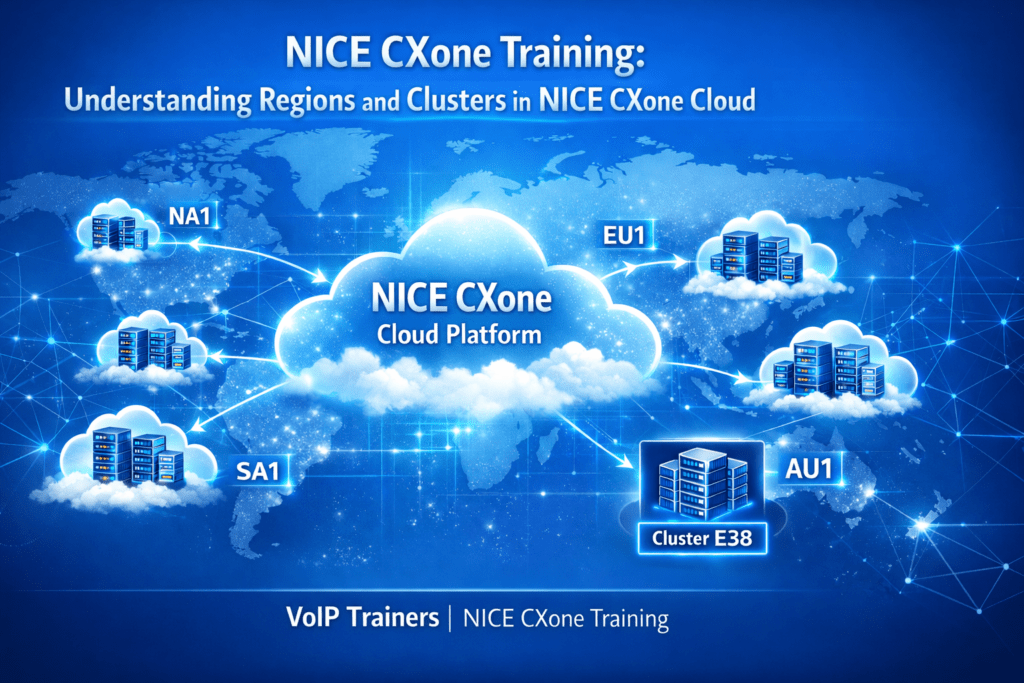
In NICE CXone, a region represents the physical geographic location where customer data and services are hosted.
Each region contains multiple data centers that run the NICE CXone cloud platform. This regional architecture helps the system deliver faster performance, improved security, and better reliability.
Using a region-based architecture provides several benefits:
• Lower network latency
• Better call quality
• Data residency compliance
• Improved disaster recovery capabilities
By hosting services closer to users, the platform ensures smoother customer interactions.
Global Regions Available in NICE CXone
Currently, NICE CXone operates across several major global regions:
• North America
• US FedRAMP
• Europe
• Asia-Pacific
• Australia
• South Africa
Each region contains multiple clusters that host customer environments and provide redundancy for high availability.
Learning about these regions is an important part of NICE CXone Training because it helps engineers understand where customer environments are deployed.
What is a Region Code?
Every region in NICE CXone has a region code, which is a short identifier used to represent the geographic location of the platform.
Region codes are often visible in login URLs and system configurations.
Some common examples include:
• EU1– Europe
• NA1– North America
• AU1 – Australia
When users log into the platform, the region code indicates where the tenant environment is hosted.
Understanding region codes helps administrators identify system environments quickly.
What is a Cluster in NICE CXone?
A cluster is a specific data center inside a region where NICE CXone services run.
Each region contains multiple clusters to support scalability and redundancy.
For example:
If a company is hosted in the Europe region (EU1), its environment may run on cluster E38.
This means the organization’s services and data are physically hosted inside the infrastructure of that specific cluster.
Clusters are critical for maintaining performance and distributing system workloads.
Because of this, understanding clusters is an important concept explained in NICE CXone Training.
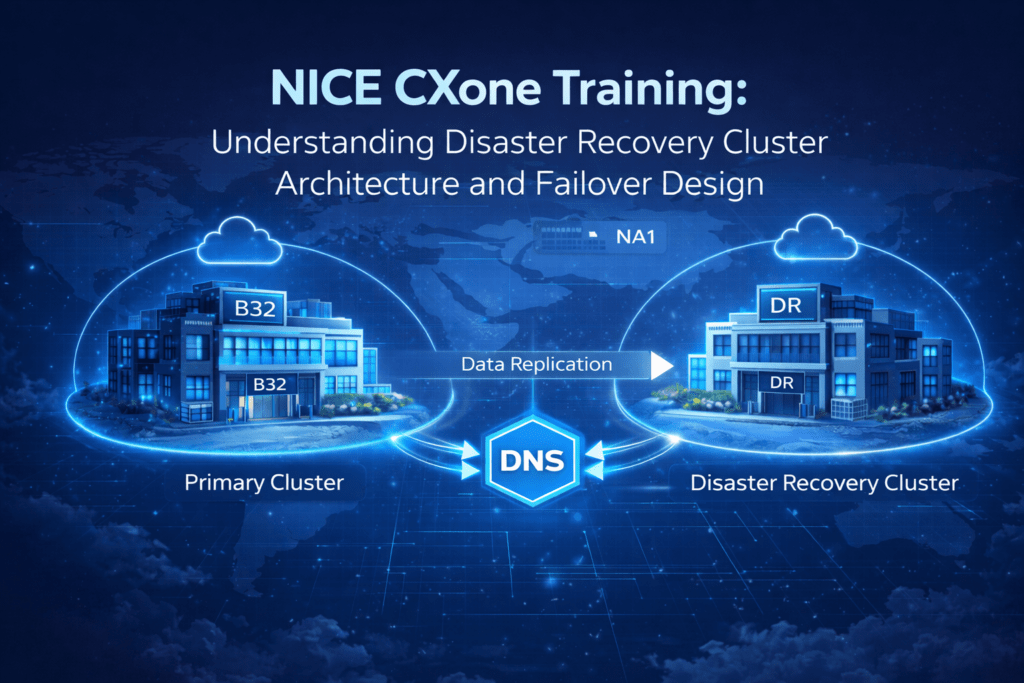
Primary Cluster and Failover Cluster
When a new tenant environment is created in NICE CXone, the system assigns a primary cluster where the organization’s services operate.
However, to ensure reliability, the platform also maintains backup clusters within the same region.
If the primary cluster experiences an issue, the platform can automatically move services to another cluster in the same region.
For example:
If a tenant is hosted on cluster M32, the system might fail over to M33 or M35 within the North America region.
Keeping failover clusters within the same region ensures:
• Data residency compliance
• Regulatory compliance
• Minimal latency impact
This architecture ensures continuous service availability.
Why Region Selection is Important?
Selecting the correct region plays a major role in performance and compliance.
Organizations usually choose a region that is geographically closer to their users. This helps reduce latency and improve voice quality.
For example:
Organizations in India or the Middle East are often hosted in the Europe region because it provides better network connectivity and lower communication delays.
Understanding region selection is a key concept discussed in NICE CXone Training programs.
Conclusion
NICE CXone training helps professionals clearly understand how regions and clusters form the foundation of a reliable and scalable cloud contact center architecture. By learning how regions define geographic hosting and how clusters manage workloads within those regions, engineers and administrators can better ensure high availability, performance, and compliance.
NICE CXone training also highlights the importance of region codes, primary clusters, and failover clusters in maintaining continuous service without disruption. This architecture ensures that even during failures, the system can quickly recover while maintaining data integrity and minimal latency.
In conclusion, mastering regions and clusters through NICE CXone training is essential for anyone looking to build expertise in cloud contact center technology and effectively manage real-world CXone environments.