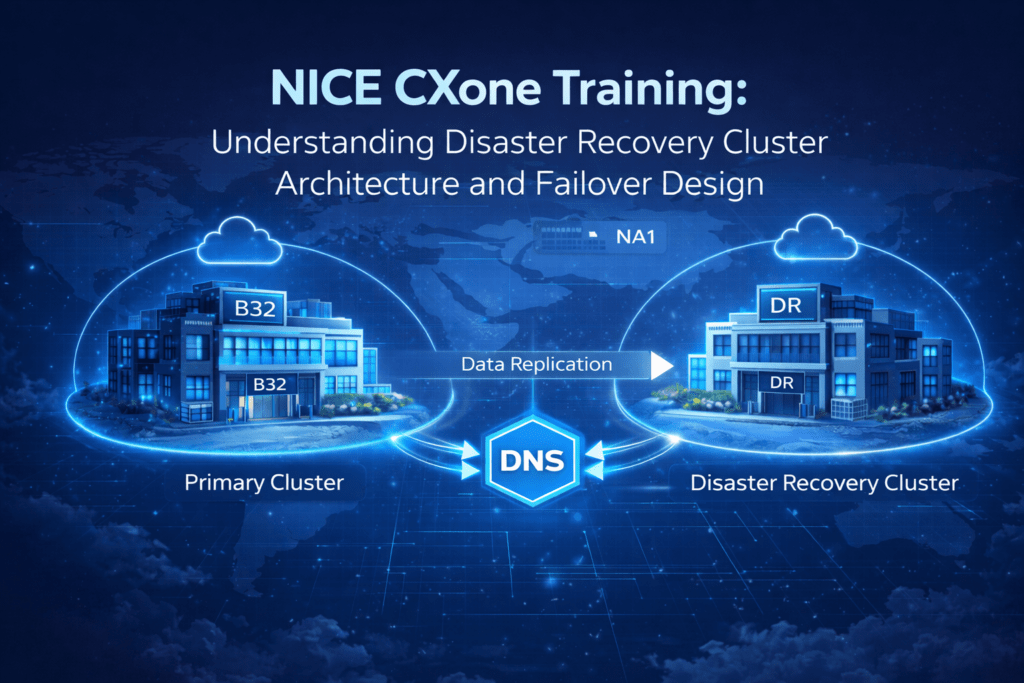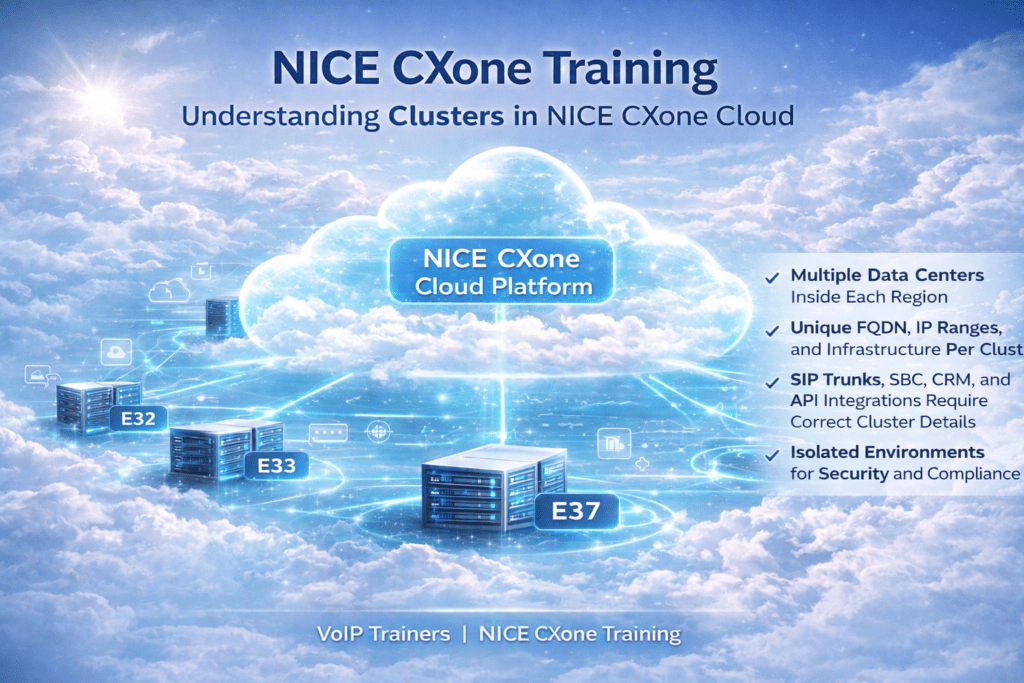
NICE CXone training helps professionals understand the infrastructure behind cloud contact center platforms, which is essential for building scalable and reliable systems. One key concept covered in NICE CXone training is the cluster architecture used by the NICE CXone cloud platform.
NICE CXone operates through multiple regions, data centers, and clusters to provide high availability and scalability for contact centers around the world.
What is a Cluster in NICE CXone?
A cluster is a group of servers inside a region that hosts customer environments (tenants).
Each region contains multiple clusters (data centers). These clusters help distribute the workload and support many customers at the same time.
The main reasons for having multiple clusters are:
- Load distribution
- High availability
- Disaster recovery
- Scalability of the cloud platform
If one data center becomes overloaded or unavailable, another cluster in the same region can continue supporting the system.
Cluster ID in NICE CXone
Each cluster has a unique cluster ID such as:
- E32
- E33
- E34
- E37
- E38
These cluster IDs identify the specific data center where the tenant environment is hosted. Even though many customers may exist in the same region, each tenant runs inside its assigned cluster.
This concept is commonly explained during NICE CXone Training because it helps engineers understand where the environment is actually running.
FQDN and IP Address of Clusters
Every cluster has its own:
- Login URL
- FQDN (Fully Qualified Domain Name)
- IP address ranges
This information is important when integrating external systems with NICE CXone.
For example, when integrating:
- AudioCodes SBC
- SIP Trunks
- Salesforce CRM
- Other telephony systems
the integration must use the correct cluster FQDN and IP address. If the wrong cluster information is used, the calls may fail.
The NICE CXone portal provides connection details such as DNS records, IP ranges, and required ports, which must be configured or whitelisted during integrations.
Why Cluster Knowledge is Important
Understanding clusters helps engineers and administrators configure integrations correctly and troubleshoot connectivity issues.
This is why topics like cluster IDs, FQDN configuration, SIP trunk integration, and region architecture are key parts of NICE CXone Training.
NICE CXone Training at VoIP Trainers
If you want to build a career in cloud contact center technologies, learning the platform architecture is the first step.
At VoIP Trainers, we provide practical NICE CXone Training that helps students, engineers, and professionals understand real-world implementations including clusters, integrations, and cloud contact center architecture.
Conclusion
NICE CXone training helps professionals understand how cluster architecture plays a critical role in ensuring scalability, high availability, and seamless performance in cloud contact center platforms. By learning about clusters, cluster IDs, FQDN, and IP configurations, engineers and administrators can effectively manage integrations and maintain stable system connectivity.
NICE CXone training also highlights how multiple clusters within a region work together to distribute workloads and support failover, ensuring uninterrupted customer interactions. This knowledge is essential for troubleshooting issues, configuring SIP integrations, and optimizing overall system performance.
In conclusion, mastering cluster architecture through NICE CXone training is a key step for anyone looking to build a strong career in cloud contact center technology and handle real-world CXone environments with confidence.