NICE CXone training helps professionals understand how modern contact centers are rapidly moving toward cloud platforms to improve flexibility, scalability, and global accessibility.
Modern contact centers are rapidly moving toward cloud platforms to improve flexibility, scalability, and global accessibility. One of the most widely used cloud contact center platforms today is NICE CXone.
For students, IT professionals, and engineers who want to build a career in cloud contact center technology, understanding the internal architecture of NICE CXone is extremely important.
This article explains the platform in a simple and practical way. The concepts discussed here are commonly covered in NICE CXone Training and NICE CX Training programs.
What is NICE CXone?
NICE CXone is a cloud-based Contact Center as a Service (CCaaS) platform that helps organizations manage customer interactions across voice, chat, email, and digital channels.
Because it runs entirely in the cloud, businesses can operate contact centers without installing complex hardware or infrastructure. Agents can work from anywhere using only a web browser and internet connection.
To support millions of interactions reliably, NICE CXone uses a powerful 3-Tier Cloud Architecture.
3-Tier Architecture in NICE CXone
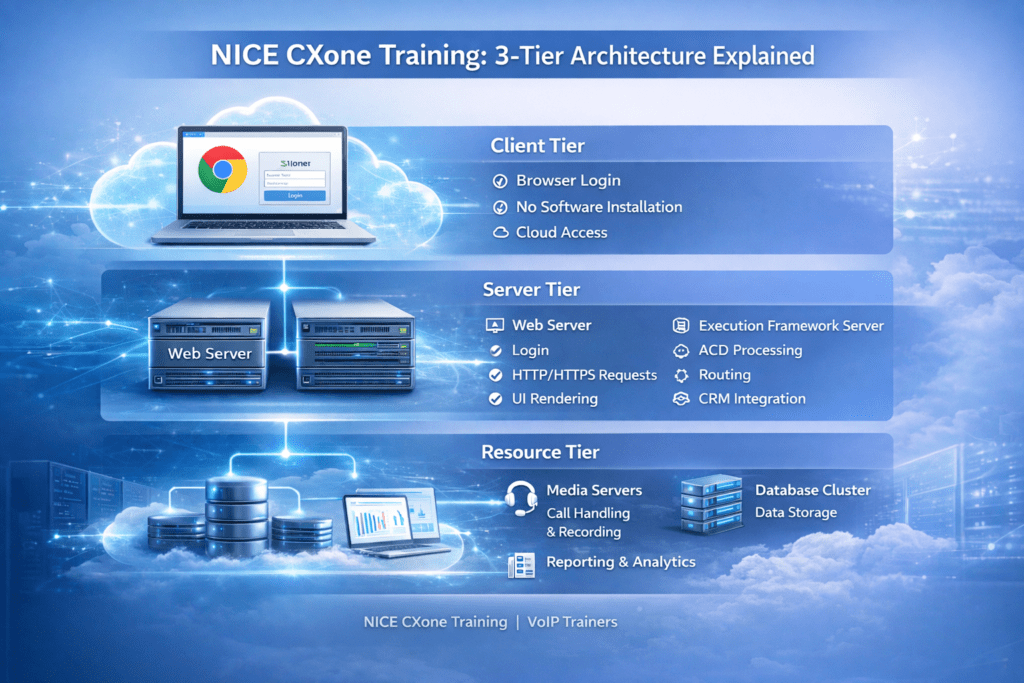
The platform is designed using a 3-Tier Architecture, which separates the system into different layers. Each layer performs a specific function in the overall platform.
The three tiers include:
- Client Tier
- Server Tier
- Resource Tier
This layered architecture improves:
• System performance
• Security
• Scalability
• Reliability
Because each layer handles a different responsibility, the platform can scale efficiently when more agents or customers are added.
Understanding this architecture is a key concept taught in NICE CXone Training programs.
Client Tier – Browser Based Access
The Client Tier is the front-end layer where users interact with the platform.
This includes:
• Contact center agents
• Supervisors
• Administrators
One of the biggest advantages of NICE CXone is that it is completely browser based.
Agents can access the system using web browsers like Google Chrome, without installing any software on their computers.
The process is simple:
- Open the browser
- Navigate to the NICE CXone login portal
- Enter credentials
- Start handling customer interactions
Because the platform is cloud based, organizations can easily support:
• Remote agents
• Work-from-home teams
• Global contact center operations
This flexibility is one of the main reasons companies adopt NICE CXone.
Server Tier – Processing and Application Logic
The Server Tier is the core processing layer of the platform.
It receives requests from the browser and executes the main system logic required to operate the contact center.
Two important components exist in this layer.
Web Server
The Web Server manages communication between the user’s browser and the NICE CXone system.
It handles several important tasks including:
• Login authentication
• HTTP and HTTPS communication
• Loading the user interface
• Managing user sessions
Whenever an agent logs in through Google Chrome, the request first reaches the web server before being processed further.
The web server ensures secure communication between the user and the platform.
Execution Framework Server
The Execution Framework Server is responsible for the core operational logic of the contact center.
This includes several critical processes such as:
• ACD (Automatic Call Distribution)
• Intelligent call routing
• Queue management
• Workflow automation
• CRM integrations
When a customer calls the contact center, this server determines which agent should receive the interaction.
Routing decisions are based on factors like:
• Agent skills
• Agent availability
• Priority rules
• Business workflows
These processes allow organizations to deliver efficient customer service.
Resource Tier – Infrastructure and Data Layer
The Resource Tier forms the infrastructure backbone of the platform.
This layer supports the entire system by managing communication services, storage, and analytics.
Several key components operate in this tier.
Media Servers
Media servers handle real-time communication between customers and agents.
They manage services such as:
• Voice call processing
• Call recording
• Audio streaming
• Voice quality optimization
These servers ensure that voice interactions happen smoothly without delays or interruptions.
Database Clusters
Database systems store the critical data required for contact center operations.
This includes:
• Agent configurations
• Customer interaction records
• Call history
• System settings
Database clustering ensures high availability and prevents data loss.
Reporting and Analytics Systems
Reporting and analytics tools collect operational data and generate performance insights.
Organizations use these insights to monitor:
• Agent productivity
• Call handling time
• Queue performance
• Customer satisfaction metrics
These analytics systems help managers optimize contact center operations.
Why Understanding NICE CXone Architecture is Important
Learning how NICE CXone works internally is valuable for professionals who want to build a career in cloud contact center technologies.
Architecture knowledge helps professionals:
• Troubleshoot platform issues
• Design scalable contact center solutions
• Understand call routing mechanisms
• Integrate external systems such as CRM platforms
For this reason, architecture concepts are an essential part of most NICE CXone Training courses.
Conclusion
NICE CXone training provides a clear understanding of how modern cloud contact centers operate using a powerful 3-tier architecture that ensures scalability, performance, and reliability. By learning how the client tier, server tier, and resource tier work together, professionals can better manage customer interactions and maintain seamless operations.
NICE CXone training also helps individuals understand critical components such as web servers, application logic, media servers, and database clusters, which play a key role in delivering efficient and secure communication. This knowledge is essential for troubleshooting issues, optimizing performance, and designing scalable contact center solutions.
In conclusion, mastering these architectural concepts through NICE CXone training is crucial for students and IT professionals who want to build a successful career in cloud contact center technology and stay ahead in a rapidly evolving digital environment.