NICE CXone Training: Understanding High Availability and DR Architecture in NICE CXone
NICE CXone Training is essential for professionals who want to understand how modern cloud contact centers maintain high availability, reliability, and business continuity. One of the most important concepts covered in NICE CXone Training is Disaster Recovery Architecture, which explains how the platform protects services during infrastructure failures. In a cloud contact center environment, system stability is critical because even a short outage can disrupt customer communication. To prevent this, NICE CXone uses a multi-layer architecture with primary clusters, disaster recovery clusters, load balancing, and database replication. Understanding how these components work together helps engineers, administrators, and IT professionals manage CXone environments effectively and ensure uninterrupted contact center operations.
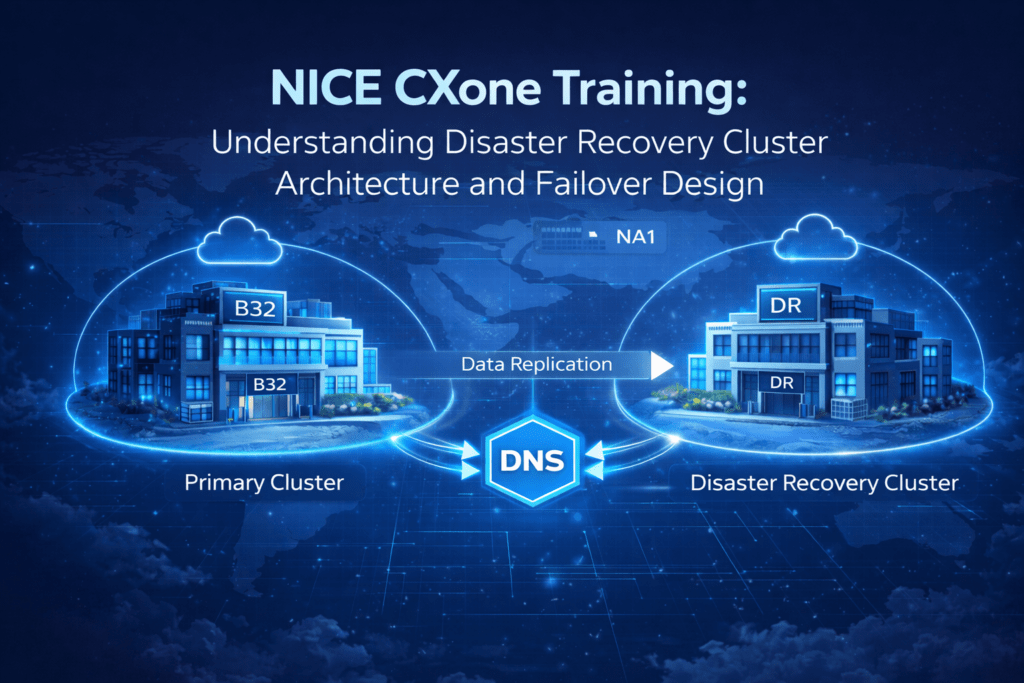
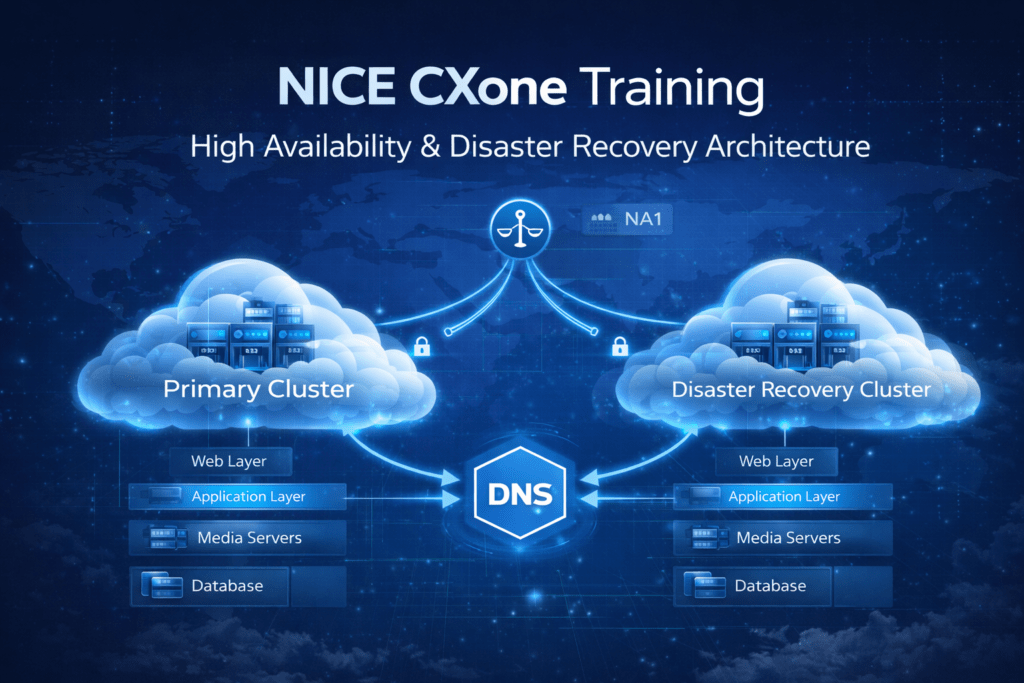
To understand this let us visualize the architecture.
The primary cluster typically includes the web layer, application layer, media services and database.
The Disaster Recovery cluster mirrors this structure with the web layer, application layer, media services and a replicated database.
The key concept here is replication.
Data from the database is continuously replicated to the Disaster Recovery database. The Disaster Recovery cluster remains in mode, synchronized and ready to take over if something happens to the primary cluster.
It is not active, under conditions but it is always prepared to take over.
This standby model ensures that when failover occurs services can resume quickly with disruption.
Modern contact centers cannot afford to be. It does not matter if call demand is high or low the platform must stay stable, responsive and resilient. This is where Disaster Recovery architecture plays a role in NICE CXone.
If you are looking into CXone training you need to understand how Disaster Recovery clusters, load balancing and service layers work together. Let us break it down clearly.
Disaster Recovery Architecture Overview – Region NA1 Example
In a NICE CXone regional deployment, like NA1 the infrastructure includes:
* Primary Cluster, which is B32
* Disaster Recovery Cluster, which is C48
* Web Servers
* Application Servers
* Media Servers
* Database Layer, which includes Primary and Replicated
Both clusters are in the region but work independently. The Disaster Recovery cluster is on standby, synchronized and ready to take over if the primary cluster becomes unavailable.
This architecture makes sure that NICE CXone has:
* Business continuity
* availability
* Minimal service disruption
* Controlled failover
The first layer is the Load Balancer, which controls traffic distribution. It sits at the entry point of the system.
Its job is to:
* Distribute HTTPS traffic across web servers
* Prevent overload on a server
* Ensure session stability
* Redirect traffic during failover
When user traffic enters the region the load balancer decides which web server will handle the request. If there is a problem with the cluster traffic is redirected to the Disaster Recovery cluster without manual help.
Understanding this traffic distribution layer is important in CXone training because it affects login stability, agent availability and overall system responsiveness.
The second layer is the Web Servers, which handle:
* Agent login requests
* UI rendering
* HTTPS requests
* Session handling
It is important to note that web servers do not process voice traffic. They only manage front-end communication between users and the application layer. If web servers are busy the load balancer distributes traffic evenly across web servers.
In NICE CXone training it is crucial to understand the difference between UI traffic and media traffic for troubleshooting.
The third layer is the Application Servers, which process:
* Routing logic
* Workflows
* Queue handling
* Business rules
* Integration logic
* Database communication
When an agent performs an action in the UI the request goes from the web server to the application server to the database and back to the web server. Application servers make sure workflows are executed correctly and consistently. If demand changes auto-scaling policies may. Remove application instances to maintain performance.
In CXone training this layer is where most configuration knowledge is applied, including skills, routing, scripts and policies.
The fourth layer is the Media Servers, which handle:
* RTP streams
* Voice session establishment
* Agent-to-customer audio connection
* Call recording triggers
Unlike web and application servers media servers process real-time voice packets. This separation ensures that UI performance does not affect call quality and voice processing remains stable.
During failover scenarios media services transition to the Disaster Recovery cluster to maintain call continuity. This architecture design is a concept in advanced NICE CXone training especially when explaining voice troubleshooting and RTP behavior.
The fifth layer is the Database, which stores:
* User data
* Call logs
* Reporting data
* Configuration settings
* Historical analytics
In the cluster the main database handles live writes. In the Disaster Recovery cluster a replicated database remains synchronized. This replication ensures that there is no data loss and immediate failover capability, which’s essential for business continuity compliance.
Understanding replication behavior is vital in NICE CXone training programs.
The full call flow in the architecture is like this:
* Agent logs in which goes to the Web Server
* Authentication request goes to the Application Server
* Configuration fetch goes to the Database
* Incoming call goes to the Media Server
* RTP session is established
* Call logs are written to the Database
* Reporting data is generated
Each layer has a job and there is no overlap or confusion. This layered separation increases system reliability and simplifies troubleshooting.
What happens if the primary cluster fails? If Cluster B32,
which is the cluster experiences failure:
* The load balancer stops directing traffic to B32
* Traffic shifts to Cluster C48, which’s the Disaster Recovery cluster
* The replicated database becomes
* Web, application and media services resume operations
The goal is to have zero or minimal service interruption. This is why Disaster Recovery clusters exist within the region to provide rapid recovery while maintaining compliance and latency control.
There are times when call demand’s low such as during seasonal business cycles, off-peak hours or scheduled maintenance windows.
In these cases:
* The infrastructure remains
* Auto-scaling may reduce active compute nodes
* Media capacity adjusts dynamically
* Database replication continues
Disaster Recovery architecture does not depend on call volume it remains active regardless of traffic levels. High availability is designed for both peak demand and low demand situations. This balance between scalability and resiliency is a core focus in NICE CXone training.
Understanding Disaster Recovery architecture is not just theoretical it helps professionals:
* Diagnose login issues
* Understand RTP routing problems
* Explain failover behavior
* Optimize routing configurations
* Prepare for audits and compliance reviews
Many implementation issues occur because teams do not understand the separation, between web, application, media and database layers. Proper NICE CXone training eliminates that confusion.
Conclusion
NICE CXone training helps professionals clearly understand how Disaster Recovery architecture ensures high availability, reliability, and business continuity in modern cloud contact centers. As explained, the combination of primary and disaster recovery clusters, load balancing, and database replication creates a resilient system that can handle failures without major disruption.
NICE CXone training also highlights the importance of each layer—web, application, media, and database—working together seamlessly to deliver stable performance and uninterrupted customer interactions. This structured architecture not only improves system reliability but also simplifies troubleshooting and operational management.
In conclusion, mastering Disaster Recovery architecture through NICE CXone training is essential for anyone looking to build a strong career in cloud contact centers, as it provides the practical knowledge needed to manage real-world CXone environments effectively.