NICE CXone Architecture Explained as a Smart Cloud City
Cloud infrastructure often feels complex. Terms like regions, clusters, disaster recovery, and high availability can quickly become confusing. But when explained in a simple way, everything becomes easier to understand.
In this article, let’s break down NICE CXone architecture using a Smart Cloud City analogy so you can understand it clearly, even if you are a beginner.
Understanding NICE CXone as a Smart Cloud City
Think of NICE CXone as a highly advanced digital city that never sleeps. This smart city is responsible for managing all customer interactions, including calls, emails, chats, and messages.
Just like a real city:
- It has infrastructure
- It has systems working together
- It runs 24/7 without interruption
But unlike a normal city, this one is distributed globally to ensure performance and reliability.
Region = Country in the Cloud
In this Smart Cloud City, a Region can be compared to a country.
For example:
- NA1 represents North America
- EU1 represents Europe
- AU1 represents Australia
Each region is designed to serve users in that specific geographical location.
Why Regions Are Important
Regions play a critical role in cloud architecture because they help with:
- Data localization (keeping data in a specific country or region)
- Faster response times
- Compliance with local laws and regulations
For instance, a company operating in Europe will prefer using the EU region to ensure that customer data remains within European boundaries.
Cluster = Buildings Within the Country
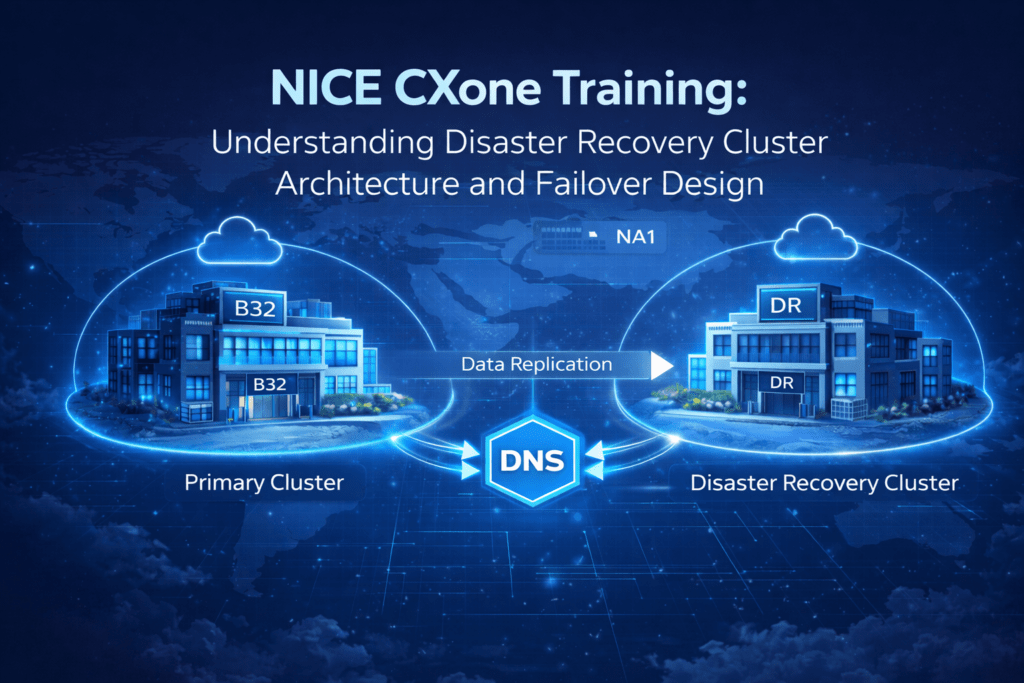
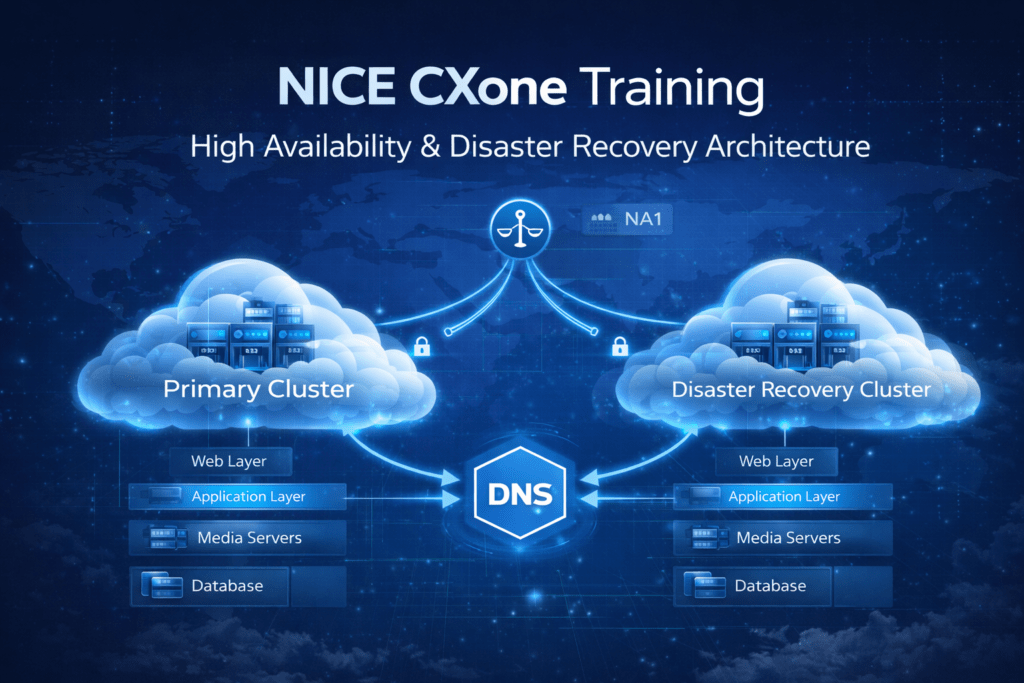
Inside each region (country), there are multiple clusters, which can be compared to buildings in a city.
Each cluster includes:
- Application servers
- Databases
- Storage systems
Instead of relying on a single system, workloads are distributed across multiple clusters.
Why Clusters Matter
Clusters improve the system by:
- Distributing traffic evenly
- Reducing system overload
- Increasing performance
- Ensuring reliability
This setup ensures that even if one part of the system is busy, others can handle the load efficiently.
Disaster Recovery (DR) – Backup System in Action
Imagine a situation where one building in the city suddenly stops working due to a power failure.
Does the entire city stop functioning? No.
Another building immediately takes over operations. This concept is known as Disaster Recovery (DR).
How It Works in NICE CXone
- Backup clusters are always available
- If the main cluster fails, traffic is automatically redirected
- Users experience little to no disruption
This ensures that business operations continue without interruption.
DNS Failover – Smart Traffic Redirection
DNS Failover can be compared to traffic management in a smart city.
If one road is blocked:
- Traffic is instantly redirected to another route
Similarly, in cloud systems:
- If one server or endpoint is unavailable
- DNS automatically redirects users to a healthy system
This plays a key role in maintaining high availability.
Why NICE CXone Architecture Matters for Businesses
For enterprises, downtime is not just an inconvenience—it can lead to revenue loss and customer dissatisfaction.
NICE CXone architecture helps businesses by ensuring:
- Continuous system availability
- Strong data protection
- Compliance with global standards
- Seamless customer experience
All these elements work together behind the scenes to deliver smooth and reliable customer interactions.
Why Students Should Learn NICE CXone Architecture
If you are planning a career in:
- Cloud computing
- Contact center technologies
- Technical support
- NICE CXone implementation
Then understanding this architecture is very important.
It helps you:
- Understand real-time system design
- Perform better in technical interviews
- Gain practical knowledge of cloud platforms
Start Learning with Practical Training
If you want to learn NICE CXone architecture with real-time examples, live scenarios, and practical sessions, you can start your training journey today.
At VoIP Trainers, we provide industry-focused training to help students and professionals build strong technical skills.
Feel free to connect with us to learn more about our training programs.